
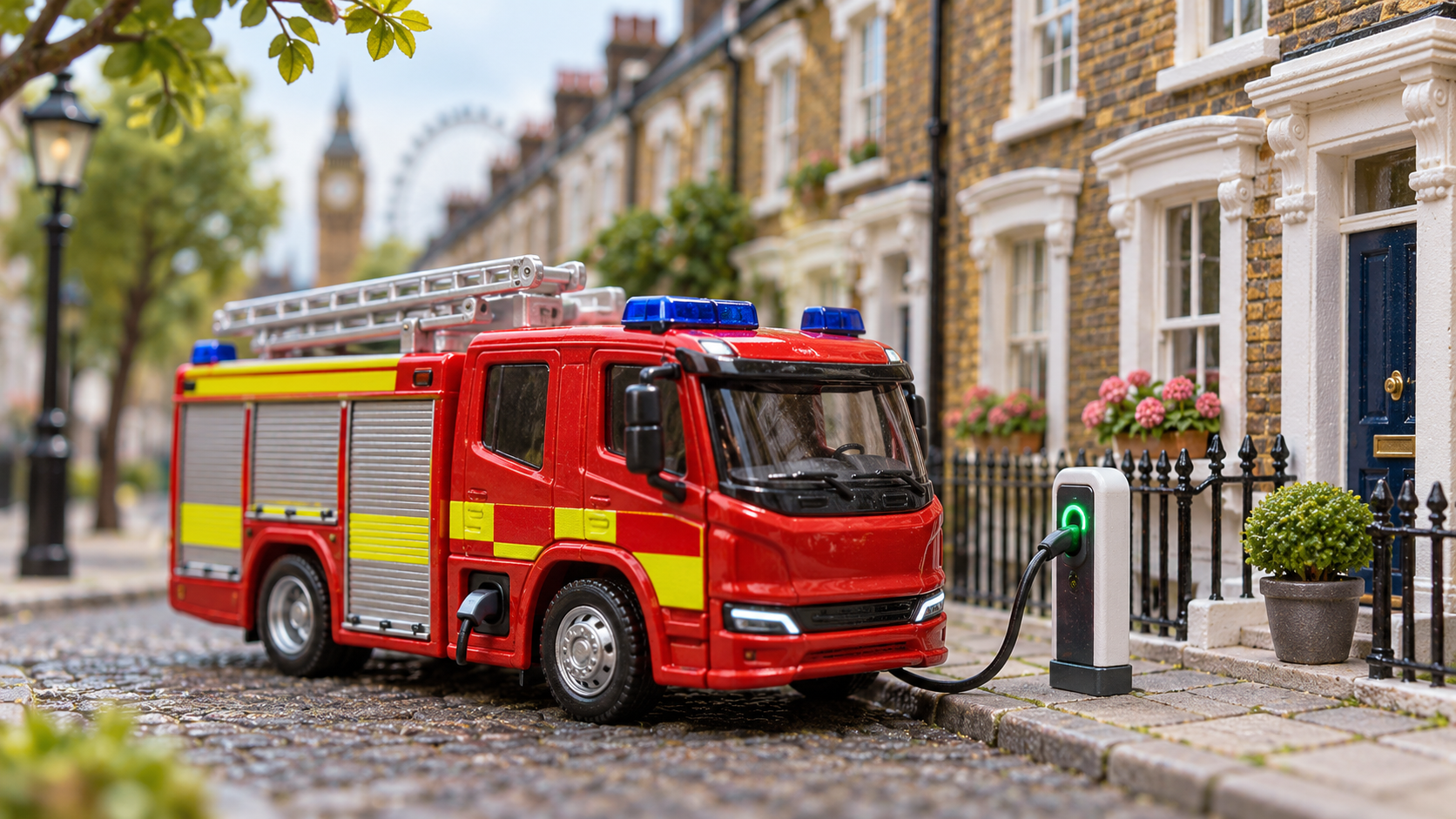
The London electric fire engine can race to a warehouse fire and then spend hours doing something that would drain an EV even without turning a wheel: pumping water. Based at Hammersmith, the London Fire Brigade’s ZEPA01 attended more than 1,500 incidents during its year-long frontline trial. The brigade says it completed every operational attendance on battery power alone, including a warehouse fire in Brent that drew 25 pumping appliances. Its combustion backup was there if needed. London Fire Brigade trial results and a photo of ZEPA01
In this article
What the London electric fire engine proved at Hammersmith
ZEPA01 joined the operational fleet at Hammersmith Fire Station in October 2025. After a year on the run, it was integrated into regular frontline service. London Fire Brigade counted 141 fires and 393 special service calls among its attendances. At Brent, the prototype worked alongside conventional appliances at a major incident. The published figures don’t say how long ZEPA01 itself pumped at Brent or how much battery it used there. Emergency Services Times trial coverage
Emergency One and Babcock Critical Services developed the prototype with the brigade. Firefighters got familiar controls, heating and air conditioning. Keeping familiar controls matters when a crew switches between vehicles on shift. London Fire Brigade estimates that the trial avoided nearly 17 tonnes of CO₂ compared with a standard diesel fire engine. That’s the brigade’s estimate for the trial. A lifecycle comparison would also need manufacturing emissions and the electricity used to charge it. London Fire Brigade emissions estimate
London electric fire engine specs and range
| Specification | Electric-hybrid ZEPA01 | Diesel Mercedes-Benz Atego DPL |
|---|---|---|
| Powertrain | Battery-electric propulsion with combustion backup | 7.7-litre diesel and Allison 3000 automatic |
| Drive output | 350 kW peak (E1 EV0 reference model) | 200 kW (272 hp), 1,100 Nm |
| Energy and range | More than 200 miles quoted for ZEPA01. Reference E1 EV0 has a configurable 280 kWh battery and up to 150 kW rapid charging. | Diesel refuelling. No comparable duty-cycle range published in the sources. |
| Water carried | 1,750 litres (E1 EV0 reference model) | Up to 1,365 litres for the cited London Atego fleet |
| Rated pump output | 3,000 L/min at 10 bar (E1 EV0 reference pump) | 3,000 L/min at 10 bar at 3 m suction lift (LFB Atego operator handbook) |
| Pumping endurance | Just under three hours at 3,000 L/min on battery in the GLA case study. The brigade’s trial report quotes up to four hours of continuous pumping. | Pump runs from engine power. No measured time at the same flow and pressure published in the sources. |
| Emissions | London Fire Brigade estimates nearly 17 tonnes of CO₂ saved during the trial versus a standard diesel appliance. | Tailpipe emissions while driving or running the pump. The trial report does not publish a standalone diesel CO₂ total. |

London’s diesel benchmark here is the Mercedes-Benz Atego dual pump ladder (DPL). Diesel figures come from London’s fleet supplier and the brigade’s Atego operator handbook. Electric figures marked “reference” come from Emergency One’s E1 EV0 platform, since the brigade did not publish a complete ZEPA01 build sheet. London Atego fleet specifications · LFB pumping appliance handbook
The London Fire Brigade release gives an overall range and pumping duration. The earlier Greater London Authority case study is more specific about pumping: nearly three hours at 3,000 litres per minute on battery power, and more than four hours with backup. A crew’s actual energy budget depends on how far it has driven, battery charge when it arrives and the pressure and flow it needs on site. GLA procurement case study
Emergency One’s reference E1 EV0 data sheet lists up to 150 kW rapid charging, regenerative braking and a 350 kW peak drive system. Its Mk II data sheet lists a 315 kWh configurable pack and a 230-mile stated range. Those figures describe different manufacturer configurations, so use the brigade’s published figures when talking about the Hammersmith vehicle. Emergency One E1 EV0 data sheet · E1 EV0 Mk II data sheet
How much energy does an electric fire engine use to pump water?
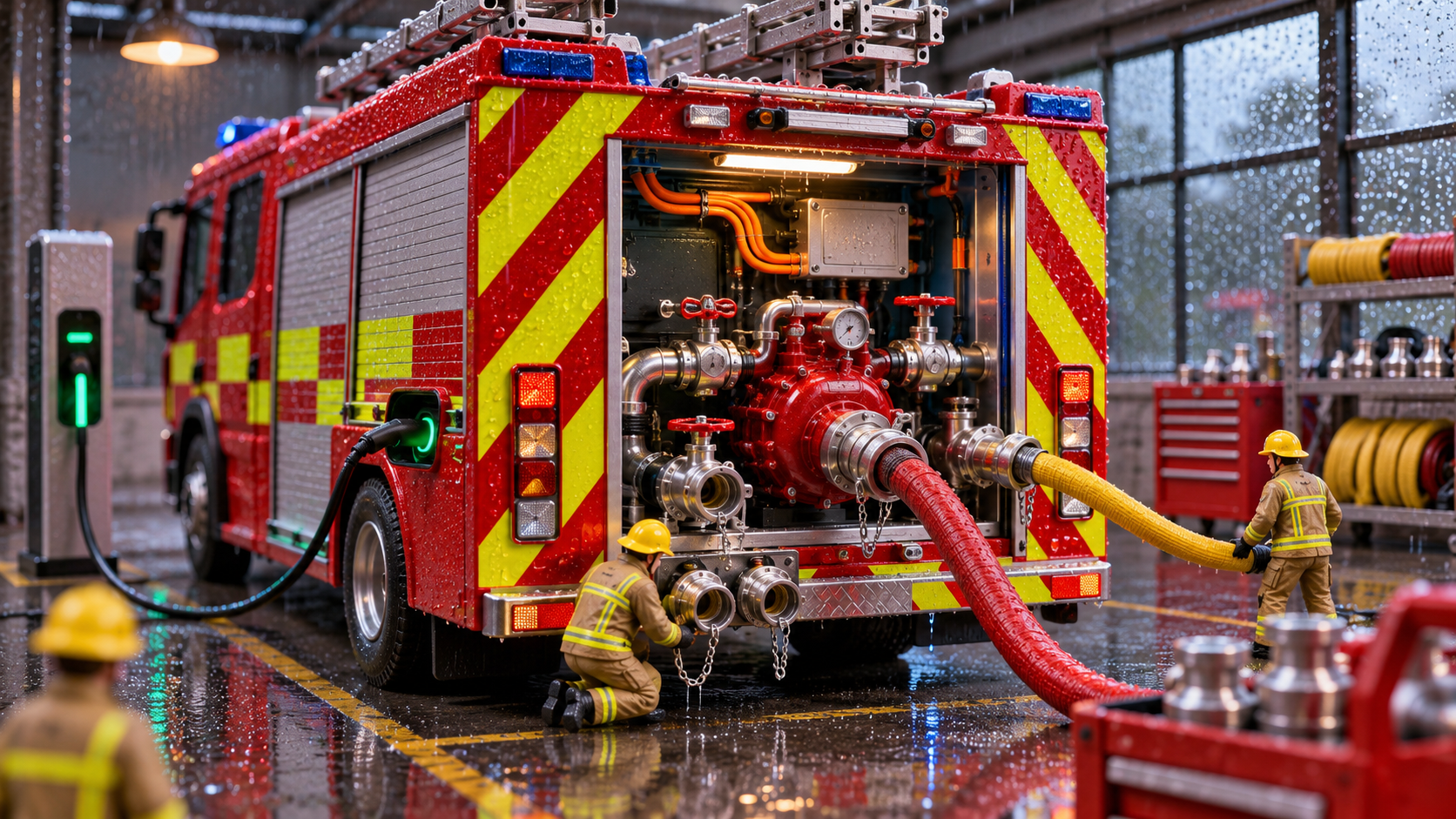
This is where the EV maths gets more interesting than miles per kWh. Emergency One’s reference pump delivers 3,000 litres per minute at 10 bar. Convert that flow to 0.05 cubic metres per second and that pressure to one million pascals. Multiplying flow by pressure gives 50 kW of hydraulic output. The battery has to supply more than that because the motor, electronics and pump all have losses. Three hours at that output would put 150 kWh of useful work into the water alone. That’s an illustration from the manufacturer’s rated point. Actual battery draw varies with the job.
The same data sheet gives a second operating point of 250 litres a minute at 40 bar. Four times the pressure sounds like it should need four times the power. With the flow reduced to one-twelfth, the hydraulic output is closer to 17 kW. Both numbers matter. An EV fire engine’s energy use can change substantially between a high-flow supply and a smaller high-pressure delivery. Manufacturer pump specifications
There’s a water calculation too. Empty a 1,750-litre reference tank at 3,000 litres a minute and it would last 35 seconds. At that rate, three hours of pumping would shift 540,000 litres. The vehicle carries enough water to begin work, while continuous high-flow pumping needs an external water supply. For the crew, water availability and electrical endurance are two distinct constraints. Essex fire authority briefing on the reference vehicle
Can London’s electric fire engines charge each other?
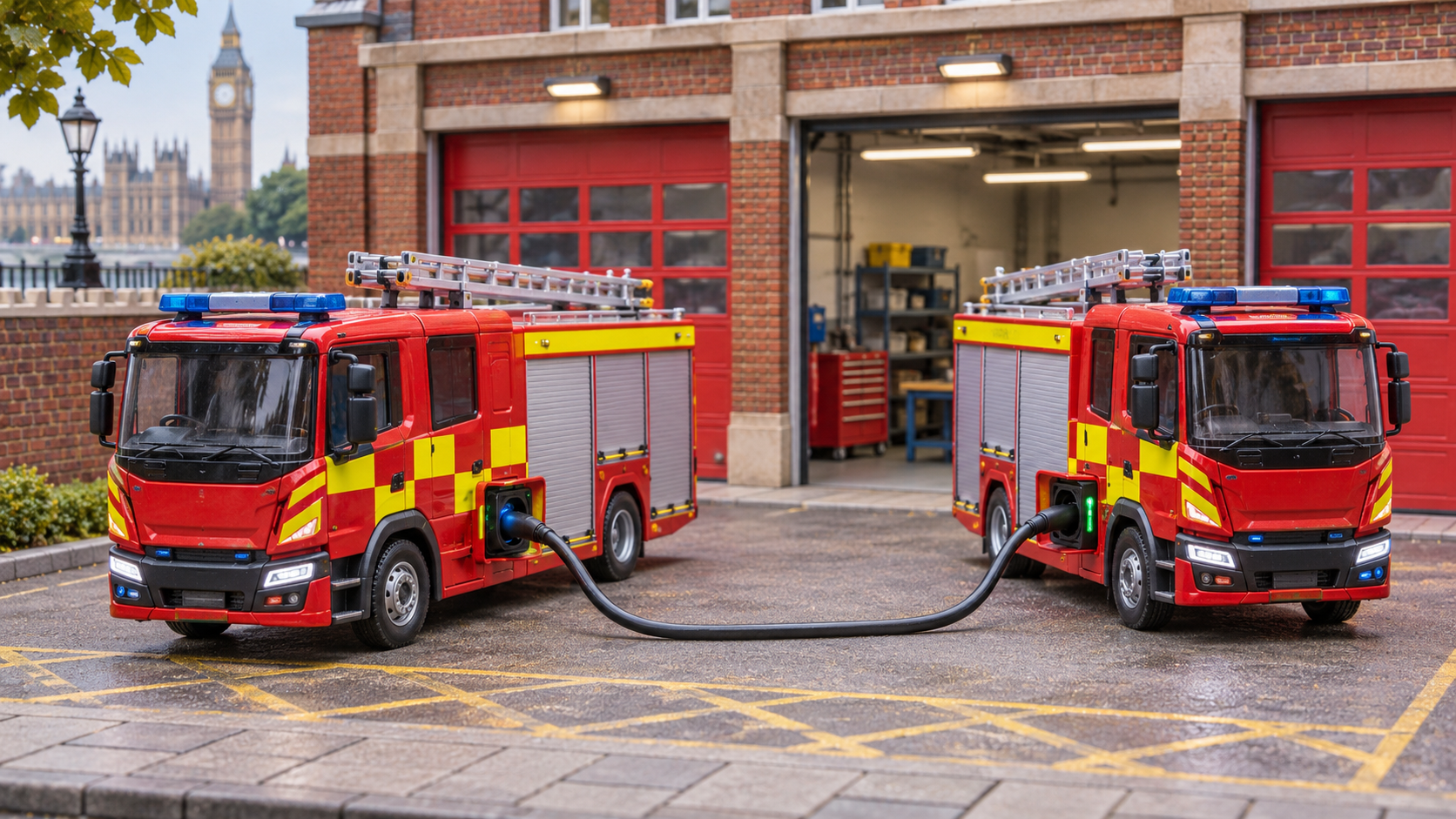
That’s what Equipmake’s ZEPA V2V project is designed to demonstrate. Equipmake, Emergency One, London Fire Brigade and Cenex have worked on linking batteries across appliances so an engine can keep pumping while energy arrives from another vehicle. Two electric appliances were shown at Cenex Expo in 2025. One concept also involves using a dedicated battery support truck. London Fire Brigade’s November 2026 update describes its fully electric V2V appliance as under development. Cenex Expo demonstration · Cenex ZEPA2 project
Think of the pump as a live load. If an attached vehicle supplies less electrical power than the operating pump and auxiliaries need, the receiving battery still drains, just more slowly. Match the load and the battery can hold charge in principle. Exceed the load and there may be power left to recharge, subject to the equipment and its limits. The figures to watch when results are published are sustained transfer power, usable energy from the donor and how often a second appliance is available to help.
Station charging presents a different problem. A fire engine’s charger has to fit around unpredictable returns and rapid turnarounds. London Fire Brigade says most stations now have EV charging, with high-powered chargers at some sites. Its own evidence to the London Assembly also highlights the cost of upgrading electrical supplies when buildings electrify their heating alongside fleet charging. A plug suitable for a training car tells you little about how many heavy vehicles the site can top up at once. London Fire Brigade evidence to the London Assembly
London electric fire engine FAQ
Is London’s fire engine fully electric?
ZEPA01 is an electric-hybrid prototype with a combustion backup. London Fire Brigade reports that it used battery power for every operational attendance during the trial. ZEPA V2V is the separate fully electric project.
Where is London’s electric fire engine based?
ZEPA01 started frontline operations at Hammersmith Fire Station in October 2025 and attended calls across London.
How long can it pump water on battery power?
The GLA documented just under three hours at 3,000 litres per minute on the battery alone. The brigade’s later release gives up to four hours of continuous pumping without specifying that same battery-only test condition.
For a passenger-car comparison, read how we costed a 400-mile electric versus diesel trip.
Leave a Reply