
EVBuyer guide · Updated 19 November 2026
Electric company car tax on a standard Tesla Model 3 could cost a 40% taxpayer about £51 a month today, rising to about £63 a month from 6 April 2027. A used Model 3 can cost your business much less to buy and still leave you with a higher personal tax bill. The figure that matters for the driver is usually the original list price when new.
On this page
1. How electric company car tax works
If your employer makes a company car available for private use, including ordinary commuting, HMRC usually treats it as a benefit in kind (BiK). The same principle applies if your own limited company provides the car to you as a director. It can apply whether the company buys or leases it.
To estimate your electric company car tax for a full year, multiply the car’s P11D value by the BiK percentage. Multiply the resulting taxable benefit by your marginal income tax rate. The P11D value generally reflects the original UK list price and relevant extras. Ask payroll for the value for the exact vehicle. Part-year availability and qualifying contributions can affect the calculation.
| UK tax year | BiK rate for a fully electric car |
|---|---|
| 2026/27 | 4% |
| 2027/28 | 5% |
| 2028/29 | 7% |
| 2029/30 | 9% |
HMRC company-car rules and calculator · Rates to 2027/28 · Finance Act rates for the next two years
2. What electric company car tax costs on a new Tesla Model 3
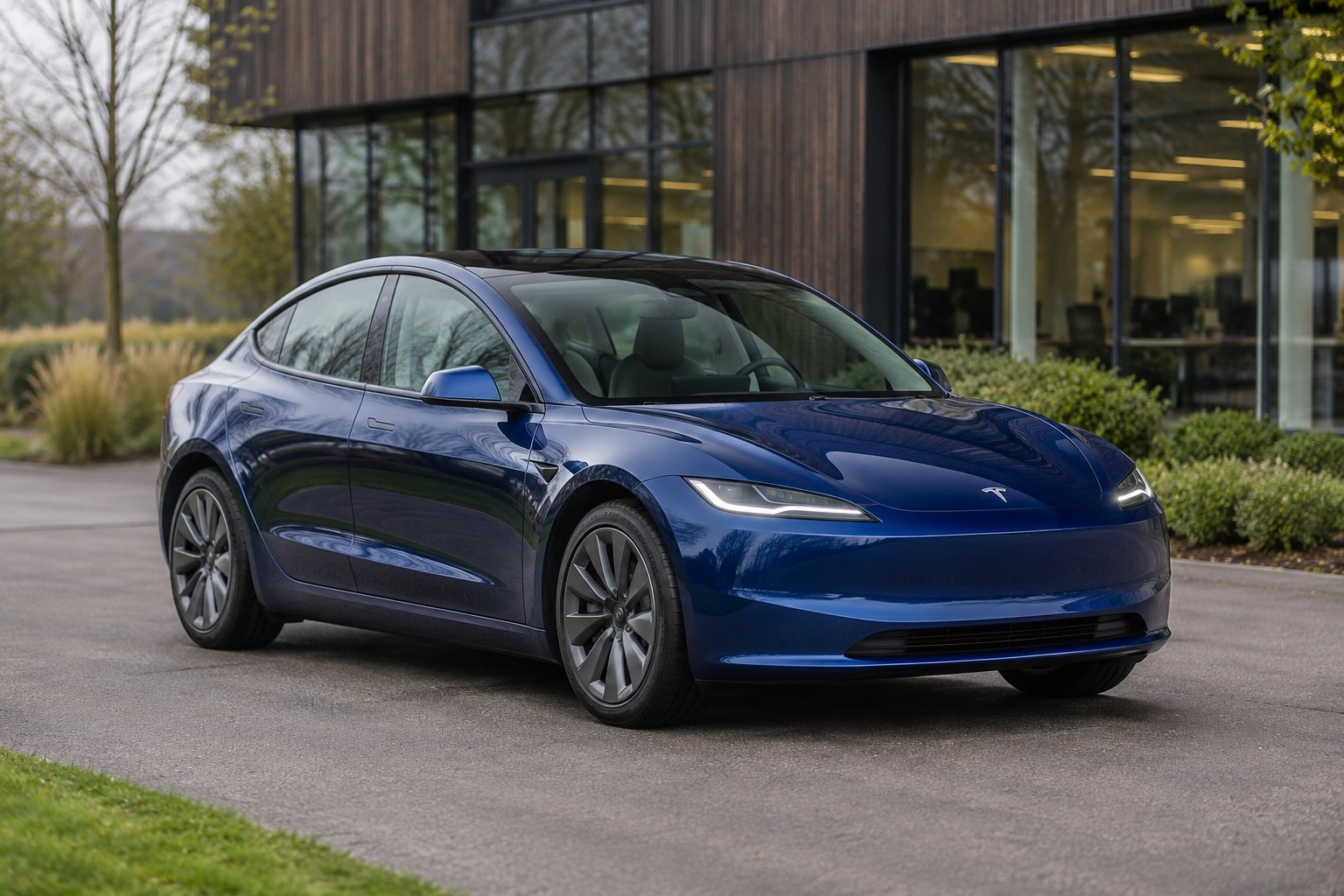
Tesla UK shows £37,990 on the road in its representative example for the entry-level Model 3 Rear-Wheel Drive. We’ve used £38,000 as an illustrative P11D value. Check the actual P11D figure with your supplier or payroll before making a decision. Tesla UK pricing.
| New Model 3 example | 2026/27 at 4% | 2027/28 at 5% |
|---|---|---|
| Annual taxable benefit | £1,520 | £1,900 |
| 20% taxpayer | £304/year · £25.33/month | £380/year · £31.67/month |
| 40% taxpayer | £608/year · £50.67/month | £760/year · £63.33/month |
| 45% taxpayer | £684/year · £57.00/month | £855/year · £71.25/month |
For a 40% taxpayer that’s £152 more per year from April 2027 on the same car. The figures are monthly equivalents for a full year of availability. Use your own marginal rate, including Scottish income tax rates if they apply. If the benefit crosses a tax threshold, part of it can be taxed at a different rate.
3. How HMRC treats a used electric company car
Say your company buys a 2022 Model 3 Rear-Wheel Drive for £20,000. That purchase price is illustrative. A published fleet specification for a 2022 example shows a £42,935 P11D value. HMRC generally uses the original list price and relevant accessories for electric company car tax. The BiK percentage is the same for new and used fully electric cars.
| Used Model 3 example | 2026/27 at 4% | 2027/28 at 5% |
|---|---|---|
| Annual taxable benefit | £1,717.40 | £2,146.75 |
| 20% taxpayer | £28.62/month | £35.78/month |
| 40% taxpayer | £57.25/month | £71.56/month |
Here the company pays much less for the used car, while the 40% taxpayer pays about £8 more per month in 2027/28 than on the new example. If you’re comparing used EVs, ask for the original P11D value of each. Trim, options and the list price at first registration can all change the answer.
HMRC’s list-price rules · 2022 Model 3 fleet specification

4. What the company pays and what it can claim
Employer National Insurance. The Class 1A rate for 2026/27 is 15%. On the new Model 3 example, the employer pays £228 for a full year, based on the £1,520 taxable benefit. That is a separate cost to the company. HMRC employer rates.
Buying new. A qualifying new and unused zero-emission car can get a 100% first-year capital allowance. The current extension runs to 31 March 2027 for Corporation Tax and 5 April 2027 for Income Tax. The allowance deducts the qualifying cost from taxable profit. The tax saved depends on the business’s circumstances.
Buying used. A second-hand EV generally goes into the main-rate capital allowance pool, currently 14% a year on a reducing balance. The qualifying purchase cost goes into the capital allowance calculation, while the original list price determines the starting figure for the driver’s benefit. HMRC business-car allowances · First-year allowance extension.
VAT and leasing. VAT recovery on buying a company car is generally blocked where it is available for private use. A business lease of a qualifying car normally has a 50% block on VAT on the lease charge, subject to the usual rules and exceptions. Compare the actual business cash costs alongside the driver’s tax. HMRC VAT guidance.
5. What changes in April 2027
From 6 April 2027, the electric company car tax percentage rises from 4% to 5%. HMRC also says employers must begin reporting company-car benefits through payroll on that date. If you run a limited company, make sure your payroll provider has the correct vehicle details and P11D value. The current first-year allowance window for companies ends on 31 March 2027. HMRC payrolling guidance.
Road tax is separate. In 2026/27, a new EV pays £10 in its first year, then the standard rate, currently £200. A 2022 Model 3 generally pays the standard rate. The expensive car supplement can apply to EVs first registered from 1 April 2025 with a list price over £50,000. The government also plans a separate 3p-per-mile charge for battery EVs from 1 April 2028, equivalent to £300 at 10,000 miles. EV road tax rules · Electric Vehicle Excise Duty measure.
If you’re replacing a company EV, ask payroll for the next car’s P11D value and get a realistic figure for the car you’re selling. That lets you compare your personal tax alongside the company’s cost to change. Get a company car valuation from EVBuyer.
Leave a Reply